Sports Channel
IPTV for Tech-Savvy Cord-Cutters: How to Stream Live Sports in 4K Without a Cable Contract
If you already run a home server, keep a Plex library tidy, and treat your router's QoS settings like a personal religion, you've probably noticed something odd: your television is the last dumb device in the house. Cable boxes are locked-down appliances running decade-old software, charging you $90 a month for 400 channels you never open. Meanwhile, the entire rest of your digital life is self-managed, optimized, and streamed over the same LAN.
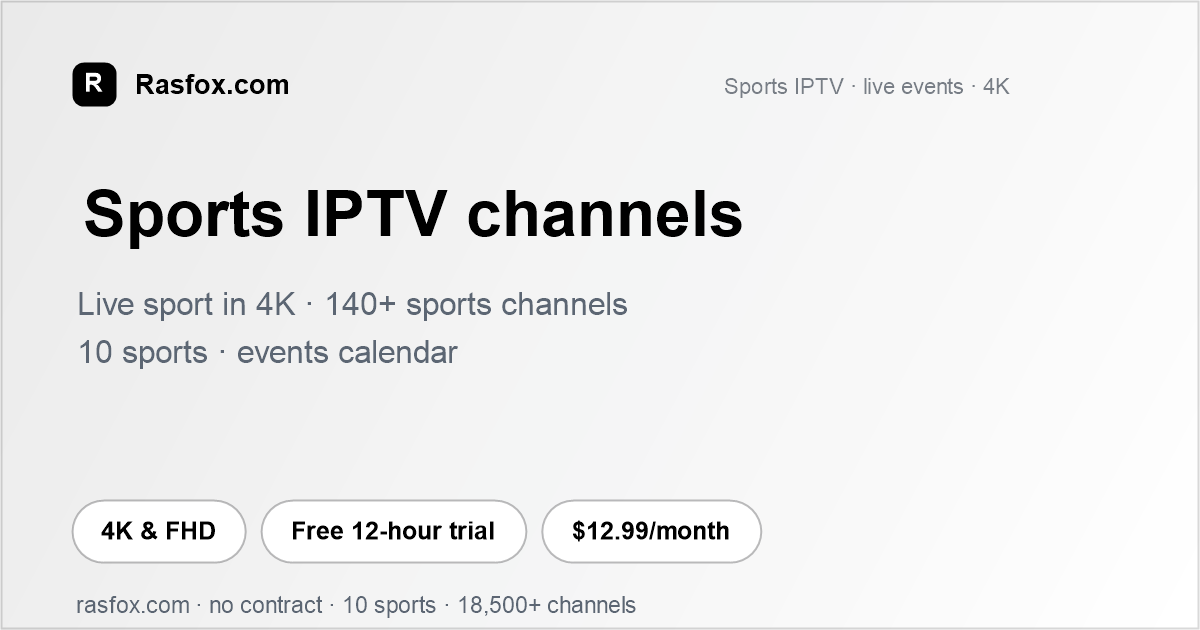
That's exactly the gap IPTV fills. Internet Protocol Television isn't a shady shortcut or a grey-market hack — it's an engineering model where your video travels over the same TCP/IP stack your other traffic does. And for people who care about bitrate, latency, and control, it's the natural endgame of cutting the cord.
In this guide, we'll look at how IPTV actually works under the hood, why it's a perfect fit for a tinkerer's setup, and how a sports-first provider like RasFox IPTV fits into a modern, contract-free streaming stack.
What Is IPTV, Really? The Engineering Behind the Buzzword
Traditional cable delivers video as a radio frequency signal over coaxial cable — a one-way broadcast where every channel is pushed to every subscriber at once. IPTV flips that model. Channels are delivered as data packets over your internet connection, requested on demand, and decoded by an app instead of a set-top box.
There are three main delivery patterns worth knowing:
- Live streaming (multicast or unicast CDN): Real-time channels delivered from edge servers. This is what powers live sports, news, and 24/7 feeds.
- Time-shifted / catch-up TV: A rolling buffer of past broadcasts you can rewind and replay — essentially a DVR living in the cloud.
- VOD (Video on Demand): A library of on-demand movies and series, streamed like any other OTT platform.
Under the hood, modern IPTV services lean on H.264 and H.265/HEVC encoding, adaptive bitrate ladders, and CDN edge caching. That's why a well-built provider can push 4K at 50FPS without the macro-blocking and stutter that plague cheap streams. When people complain about "buffering," they're usually describing a provider that over-subscribed its servers — a capacity problem, not a technology problem.
Why It Beats a Cable Box on Every Technical Metric
- No hardware lock-in. Run it on a Fire TV Stick, an Nvidia Shield, an Apple TV, a Raspberry Pi with Kodi, or even VLC on your desktop.
- Standard protocols. Most services expose M3U playlists or Xtream Codes API endpoints — you can pipe them into whatever client you prefer.
- EPG support. XMLTV electronic program guides give you a proper grid, just like a legacy tuner.
- Scalable quality. Your picture is limited by your bandwidth, not by which cable tier you paid for.
For anyone who's ever spent an evening flashing firmware onto a media player, that flexibility is the whole point.
The Thematic Bridge: Why an IPTV Stack Fits a Tinkerer's Life
Here's the connection most cord-cutting guides miss. If you already treat your home network like a small private data center — segregating IoT devices onto a VLAN, running a DNS sinkhole, keeping a NAS for local media — then IPTV with 12,000 live channels and 40,000 on-demand titles is just one more client on that network. It's not a replacement for your setup. It's an extension of it.
You get the same satisfactions you get from self-hosting: choosing your own client, tuning your own buffer settings, controlling your own hardware lifecycle. The difference is that someone else handles the encoding infrastructure, the CDN, and the licensing headaches.
The other half of the bridge is sport. Live sports is the single hardest thing to pirate reliably, the single most expensive thing to buy à la carte, and the single most popular reason people keep paying for cable. A sports-focused IPTV subscription with 4K live events solves the exact problem that keeps the cable box plugged in.
Built for Sports Fans: Inside the RasFox Channel Lineup
RasFox.com didn't start as a generic streaming aggregator. Its roots are in radio: Radio Malena 89.1 FM, Buenos Aires (Venezuela 370) — a station steeped in tango and Argentine cultural tradition. When the team moved from broadcast audio to IP-delivered video, they kept the same DNA: live, scheduled, appointment-based content. That's why the platform is built with a total focus on sports channels and live sports events, rather than a random dump of 12,000 feeds.
For English-speaking viewers, that means the major global sports networks are front and center:
- Worldwide: ESPN, DAZN, Fox Sports, beIN Sports, Sky Sports, Eurosport
- United States & Canada: ESPN, ESPN2, Fox Sports 1, TNT Sports, CBS Sports, NBC Sports
- Latin America: TyC Sports, ESPN Premium, TNT Sports Argentina, Fox Sports, DirecTV Sports
- Brazil: Globo, SporTV, Premiere, ESPN Brasil, BandSports, Combate, TNT Sports BR
- Portugal: Sport TV 1–6, Eleven Sports, Benfica TV, Porto Canal, DAZN Portugal
And the competitions that actually matter: the Champions League, Premier League, La Liga, Brasileirão, Copa Libertadores, Liga Portugal, Liga Argentina, the NFL, NBA, MLB, NHL, Formula 1, and UFC pay-per-view cards.
Why Shared Pedigree Matters for Latino and Lusophone Viewers
Because the platform grew out of an Argentine radio tradition, the Latin American and Brazilian channel lineups aren't an afterthought bolted onto a US-centric service. Support is available in Portuguese and Spanish, and the team understands the region's sports calendar — the Libertadores nights, the Brasileirão rounds, the Argentine league fixtures — as native programming, not imported filler.
If you're an expat in Miami, Madrid, or Berlin who still wants Sunday Argentine football in the original commentary, that's the use case RasFox was literally designed around.
IPTV in the United States: The Cord-Cutting Capital of the World
The US is the most mature IPTV market on the planet, and also the most legally scrutinized. Two things are true simultaneously:
- Broadband penetration and speed make high-bitrate streaming genuinely viable almost everywhere. Verizon Fios, Xfinity, AT&T Fiber, and Google Fiber routinely deliver 300 Mbps–2 Gbps to the home.
- Content licensing is aggressively enforced. The DMCA, ISPs' copyright alert systems, and rightsholder litigation mean the source of your stream matters far more than the technology you use to watch it.
The practical takeaway for a technically literate cord-cutter is straightforward: IPTV as a delivery technology is completely legal; unlicensed rebroadcasting is not. The differentiator is whether your provider holds distribution rights for the channels it offers.
What Americans Actually Want to Watch
Regional sports networks, national broadcasts, and international leagues dominate search traffic. A typical US-focused viewer wants:
- NFL Sundays without a $70/month live-TV bundle
- NBA and MLB out-of-market games
- Premier League and Champions League mornings
- Formula 1 race weekends
- UFC numbered events
Sports aside, the platform's 40,000-title VOD library covers the back catalogue most households actually binge between fixtures — so you're not paying for a sports subscription and a separate streaming service.
The ISP Variable Nobody Talks About
If you're in the US on a cable connection with a data cap — 1.2 TB is the common ceiling — a 4K stream at sustained bitrate will chew through it fast. Rough math: a 4K channel at roughly 15–25 Mbps burns around 7–11 GB per hour. Six hours of weekend sport is a meaningful chunk of your month.
Fiber providers are usually uncapped. If yours isn't, consider dropping to 1080p for background viewing and reserving 4K for the matches you actually care about. Your IPTV service with configurable stream quality will usually let you pick per-channel.
Hardware and Setup Guide for the Home Lab Crowd
This is the part where a tech audience has a genuine advantage. IPTV clients are lightweight; the bottleneck is almost always the network, not the CPU.
Client Devices, Ranked by Enthusiast Preference
- Nvidia Shield TV Pro: The gold standard. Hardware HEVC decode, wired Ethernet, AI upscaling, handles 50FPS 4K without breaking a sweat.
- Apple TV 4K: Excellent silicon and a clean interface, though client app selection is narrower than Android TV.
- Fire TV Stick 4K Max: The best price-to-performance ratio. Add a USB Ethernet adapter if your Wi-Fi is congested.
- Raspberry Pi 4/5 + Kodi: Maximum control, minimum cost. Use a proper PVR IPTV Simple Client with an XMLTV EPG source.
- Android TV boxes: Wide compatibility; quality varies wildly. Buy from a reputable brand with a real HEVC decoder.
- Desktop (VLC / mpv): Perfect for testing a playlist before committing it to a living-room device.
Network Tuning Checklist
- Go wired where you can. A $15 Gigabit switch and a Cat 6 run beats any mesh system for jitter.
- Reserve bandwidth with QoS. Mark your streaming device as high priority in your router's traffic shaping rules.
- Use 5 GHz or 6 GHz, never 2.4 GHz. The 2.4 GHz band is a swamp of interference in most apartment buildings.
- Set a sane buffer. Some clients let you increase the pre-buffer from 2 to 5 seconds. It costs a little latency and buys near-total stability.
- Test before you commit. A 24-hour free IPTV trial is enough to measure real-world stability on your own connection, at your own peak hours.
Pro tip for the home lab: isolate your streaming devices on their own VLAN or guest SSID. It keeps your media traffic from competing with backups, torrents, or a runaway Docker container, and it makes troubleshooting dramatically easier.
Legal vs. Illegal IPTV: What Smart Streamers Should Know
This is the section that separates a durable setup from a short-lived one. The technology is neutral. The licensing is everything.
Red Flags of an Unlicensed Service
- "Lifetime" subscriptions for a one-time fee. No legitimate distributor can sell you perpetual rights to live sports.
- No company identity, no terms of service, no billing transparency.
- APK-only distribution. Sideloaded apps from Telegram channels or random file hosts are a common malware vector — especially on Android boxes.
- Crypto-only or gift-card payment. A legitimate business takes traceable payment.
- Prices far below market. Sports rights cost real money. If a service undercuts everyone by 90%, it isn't licensing anything.
Green Flags to Look For
- A clear subscription model with recurring billing and refund terms
- Documented client support (M3U / Xtream / official apps)
- A free trial period so you can evaluate stability honestly
- Customer support in real languages, with real response times
- Transparent channel and VOD catalogue rather than vague "everything" claims
By those criteria, the best IPTV service for cord-cutting sports fans is one that competes on infrastructure and support rather than on being the cheapest. RasFox fits that profile: a documented catalogue of 12,000 channels and 40,000 VOD titles in 4K 50FPS, two simultaneous connections per subscription, no long-term contract, and support in Portuguese and Spanish for its Latin American and Brazilian audiences.
If you're in a jurisdiction with strict enforcement — the US, UK, Germany, Australia — the safe move is always the same: use a provider that presents itself as a licensed service, keep your payments traceable, and treat absurdly cheap offers as a signal, not a bargain.
Do You Need a VPN?
A VPN is not required to use IPTV legally, and it won't make an unlicensed stream legal. What a VPN does do is encrypt your traffic on untrusted networks — useful if you travel and want to watch from a hotel Wi-Fi. A reputable VPN with WireGuard support and low overhead is a reasonable addition to any travel kit for the privacy-conscious streamer.
Pricing, Screens, and the No-Contract Advantage
The economic argument for IPTV over cable is not subtle. A traditional US cable package with sports tiers routinely runs $80–$150 per month, plus equipment rental, plus regional sports network fees, plus a two-year contract with an early termination penalty.
A modern IPTV subscription, by contrast, is typically:
- Contract-free — month-to-month, cancel whenever
- Multi-device — RasFox includes two simultaneous screens, so the living room and the bedroom can watch different matches at once
- Hardware-agnostic — no rented box, no activation fee
- Bundled — live TV and a 40,000-title VOD library in one subscription
For a household that was paying for cable plus two streaming services, the savings are usually measured in four figures per year.
Frequently Asked Questions
Does IPTV buffer? How do I stop it?
Buffering is almost always caused by one of three things: insufficient bandwidth (under 25 Mbps for 4K), Wi-Fi congestion (fix with 5 GHz or Ethernet), or an under-provisioned provider. Choose a service with real CDN infrastructure, connect your streaming device by cable, and set a 3–5 second client buffer.
How much internet speed do I need for IPTV in 4K?
Plan for roughly 25 Mbps of sustained throughput per 4K stream, and around 8–10 Mbps for 1080p. If two people are watching simultaneously, double it. A 100 Mbps connection comfortably handles two 4K streams plus normal household browsing.
Can I run IPTV on a Raspberry Pi or with Kodi?
Yes. Kodi's PVR IPTV Simple Client accepts an M3U playlist and an XMLTV EPG URL. A Raspberry Pi 4 or 5 handles 1080p comfortably; for smooth 4K 50FPS, a device with hardware HEVC decoding — like a Shield or a Fire TV Stick 4K Max — is the better choice.
Is IPTV legal in the United States?
IPTV as a delivery technology is entirely legal. What matters is licensing: a provider must hold distribution rights for the channels it retransmits. Using a licensed service is legal; subscribing to an unlicensed rebroadcaster is not and can expose you to ISP notices and legal risk.
Can I watch the Champions League, NFL, and Formula 1 on RasFox?
RasFox is built around live sports. Its lineup covers the Champions League, Premier League, La Liga, Brasileirão, Copa Libertadores, the NFL, NBA, MLB, Formula 1, and UFC, alongside 12,000 channels and 40,000 on-demand titles — all in up to 4K 50FPS.
Is there a free trial?
Yes. RasFox offers a 24-hour free trial with no contract and no obligation, which is the correct way to evaluate a streaming provider: test it on your own network, during your own peak hours, with the channels you actually watch.
The Bottom Line: Build Your Stack, Then Stream It
If you already optimize your network, choose your own clients, and refuse to rent hardware you could own, IPTV is the logical conclusion of that philosophy. It replaces a locked-down cable box with a configurable stream, a 12,000-channel lineup with genuine depth in live sports, a 40,000-title VOD library, and two simultaneous screens — all without a contract.
The technology isn't the risk. The provider is. Pick one with a real catalogue, real support, and a trial period long enough to prove itself on your connection.
Start with the 24-hour free IPTV trial at RasFox.com, run it on your own hardware, and see how it performs on Champions League night. If your network is tuned properly, you won't miss the cable box — or the bill — at all.